Brands, this one is for you.
You spend a year on a line. You develop it, sample it, correct it, kill the two pieces that were not working, name the rest. You book the photographer and the studio day. You grade the sizes, spec the packaging, negotiate the freight. By the time an order lands on a retailer’s floor, you have put more work into that product than anyone downstream will ever see.
Then it gets to the 99th yard line and stops.
Not because the product is wrong. Because the information about the product did not make the trip. And the retailer, who wants to sell it as much as you want it sold, is now retyping your line sheet into a website by hand at nine at night.
What we can see
Invoe is the retail inventory operations platform independent shops use to carry a wholesale order from the moment it is written, through receiving, onto the shelf and onto the site. Which means we watch the handoff between you and your accounts from the inside, at volume.
Since March: 1,178 purchase orders. 317 brands. 7,766 products. 43,249 units. $2.6 million in wholesale. To place all of it correctly we hold 170,057 rows of existing catalog across the connected stores, because every incoming order has to be checked against everything the shop already sells.
That is the pile. Now here is the part that should get your attention.
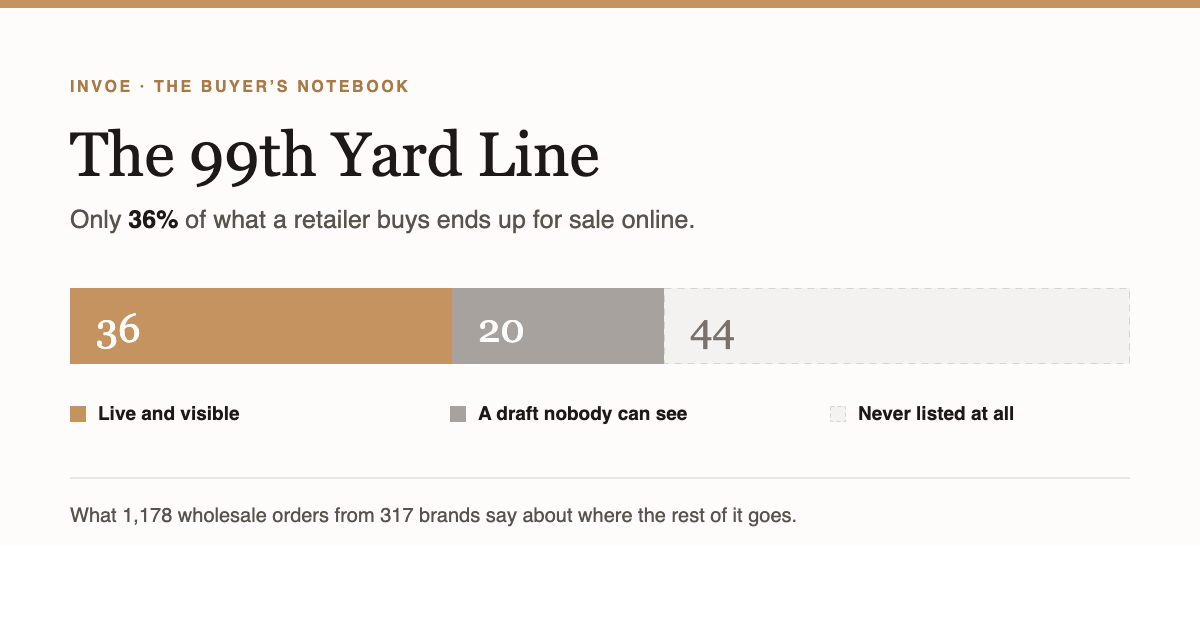
Of every 100 products a shop buys
36 are live and visible to a shopper.
20 made it to the website as a draft. They exist. They have a page. Nobody can find them, because a draft is invisible to a customer, invisible to search, and invisible to the shop’s own site.
44 never got out of the back office at all. More than half of those have been sitting for over a month. Eight hundred and sixty-four have been sitting for over three.
Sixty-four out of every hundred products you shipped are not for sale on the internet. Not returned. Not rejected. Not sitting in a stockroom because they did not sell. They never got listed. Your retailer paid you for them, took delivery, put them on the floor, and the online version of that product simply never happened.
Think about what that costs, on both sides of the invoice. Your product is not indexed, so nobody searching your brand name plus that style finds a stockist. The shop’s site shows a thinner assortment than the shop actually has. Nobody can buy it after closing time. And when the season ends and you look at sell-through to decide what to reorder, you are reading a number that was never given a fair chance.
“The floor sold what the floor could see. The internet never saw it at all.”
Why we are writing this down instead of keeping it to ourselves
Because we are not on opposite sides of this table, and the industry keeps behaving like we are.
You want your product sold, photographed well, described accurately, and turning up when someone searches for it. Your retailer wants exactly the same thing, plus stock counts that do not lie. There is no version of this where one of you wins and the other does not.
Independent retail is having a real moment. There is more good product within reach of a small shop than there has ever been, and more ways to find it. The thing standing between that and a great year is almost never the product. It is a spreadsheet column.
So here is what we can see from our seat, in the order it costs you.
1. A photograph with every single item
Of the 5,775 products that came to us as brand-new listings, 2,580 arrived with no image at all. Forty-five percent.
Somewhere a photo of that product exists. You paid for it. It is in a line sheet PDF, or a Dropbox link that expired, or on a rep’s phone. It just did not travel with the order, so the person putting your product online has three options: chase your rep, shoot it themselves on the stockroom floor, or publish a gray box.
We will be straight with you about this one, because we checked. In our data, a missing photo does not predict whether a product gets listed. Shops publish it anyway and fix the picture later, or shoot it themselves.
What it predicts is how your product looks when it gets there. A stockroom phone photo against a white wall, taken at nine at night by someone who has forty more to do, is now the image representing a garment you spent a studio day on. That image gets indexed. It shows up in image search under your brand name. It sits next to your own beautiful photography and quietly undercuts it.
You do not lose the listing. You lose control of how your line looks in every shop that carries it.
2. A SKU that means one product, forever
Almost everybody sends a SKU. 96% of products arrive with one. That part is solved.
What is not: 446 brand-and-SKU pairs in our system point at more than one different product name. That is 1,335 line items across 93 brands where the same code means one thing in spring and something else in fall.
When a SKU gets reused, a retailer’s system either creates a duplicate listing or, worse, quietly stacks this season’s units onto last season’s product page. Their sell-through report for you now says something that is not true. You are being measured on numbers your own numbering created.
A SKU is a promise that a code points at exactly one thing. Keep the promise and you can be tracked accurately for years.
3. Name the colorway like you will need to find it again
Across the orders we have processed there are 1,355 distinct color names. Half of them, 671, appear exactly once. Names in the shape of these: “heather stone / obsidian-mtx”, “driftwood + pale ember”, “247 verde”, “chapter two”, “marguerite’s afternoon”.
Some of that is real brand personality and nobody is asking you to give it up. But two failures show up over and over.
The first is the quiet rename. The shirt was Navy last year. This year the identical shirt is Ink. Nothing else changed. Now it is a new product on your retailer’s site, the reviews do not carry, and two years of sell-through on one style reads as two separate half-stories.
The second is the name that is not a name. “247” and “chapter two” do not tell anyone anything. They cannot be searched, filtered, or matched against last season.
If the color genuinely changed, give it a new name and mean it. If it did not, keep the old one. And if you are recoloring a carryover style, say so on the order.
4. One document, with everything in it
This is the one that moves the number.
Products that arrive with a UPC get listed 69% of the time. Products without one get listed 54% of the time. Fifteen points, and it is the widest gap of any field we measured. Only 9% of the products we see arrive with a barcode at all.
We will not overclaim the cause. Brands that send UPCs probably send better everything. But that is exactly the point, and it leads somewhere useful.
The real problem is not the format of your order. Your orders reach us in eight different shapes already: PDFs, spreadsheets, JOOR exports, NuOrder, Faire, other marketplaces, phone photos, and typed by hand. Invoe reads all of them.
The problem is that the information needed to list one product is currently scattered across four places. Cost is on the order. The UPC is in a portal. The fabric content is on a PDF from March. Suggested retail is in an email from your rep. Listing one product means a scavenger hunt, and a scavenger hunt at scale means shortcuts, and shortcuts are how a product ends up as a draft.
Put it in one document, per style:
SKU, unique and permanent.
UPC or barcode.
Color name, distinct and spelled the same way every time.
Size run.
Cost price.
MSRP, if you have one.
Suggested markup, if you would rather give the multiplier than the number.
Product description, the one you would want a customer to read.
Fabric, materials, care, country of origin.
Image URL.
Ten fields. One file. Sent once. You already have every one of these somewhere. The work is not creating them. It is putting them in the same place, so nobody has to log into anything to sell your product properly.
5. Ask each other for what you need
Wholesalers and retailers are partners, and a lot of the time they behave like strangers who happen to exchange invoices.
Retailers: if you need better photos, a spreadsheet instead of a PDF, or UPCs on the order, ask your rep. Nine percent barcode coverage is not refusal. Most brands have never once been told it matters, because nobody asked.
Brands: if you want your product showing up in more shops, with real photography and honest stock counts, ask your accounts what would make that easier. The answer is usually one file and it is usually free.
What Invoe does with the data you send
Here is our stake in this, said plainly. Everything above is the input. Invoe is what happens to it next.
When a shop runs on Invoe, the order you send stops being a document somebody re-types. It becomes the receiving layer: the single record the whole operation runs off. The same file that tells the shop what is coming tells them what arrived, what was short, what it truly cost after freight, what it should retail for, and what to put on the website. One source of truth from the order through receiving to the shelf, instead of four systems and a spreadsheet that disagree by Friday.
The better your document, the further that carries with no human retyping anything.
That is the whole compounding loop, and it runs in your favor. Good data in means the shop receives faster and with fewer questions to your rep. Faster receiving means product goes live in days instead of drafts. Live product means it gets found, gets sold, and gets counted. Accurate counts mean your sell-through report is real, so the reorder is based on what actually happened. A real reorder is the beginning of an account that carries you for years instead of a season.
That is not software doing something clever. That is the information you already produce finally arriving somewhere it can be used.
The last yard
Neither side of this is trying to make the other’s job harder. Both sides are just busy, and the handoff between you was never designed. It accumulated.
You have already done the expensive part. You made the thing, you paid for the photos, you got it on a truck. Your retailer did their expensive part too. They bet their own money on your line and gave it floor space.
Everything after that is a spreadsheet column, and we would all rather be selling.
Sixty-four out of a hundred is not a product problem. It is a paperwork problem, and paperwork problems are fixable.